Friday, April 8, 2011

An evening with the ugly duckling!

No kidding! California Theatre Center, CTC presents plays for school-age kids and their families. These plays are based on some of the classics that the kids know. The one that we went for was "The Ugly Duckling". Both my kids knew the story, so they were excited to see the play.


Before the play began, there were booths for face painting and origami duck making. There was also outdoor duck play activities.

The opening scene immediately caught the kids attention. It was a set of farm and there were 5 actors immitating playful farm animals. The play was fast moving and it was unbelievable that only 5 actors carried out the entire play. There were few songs in the play, many hilarious scenes and there was a message too : "You should not be afraid of being yourself!"

The play lasted for about 50 minutes (just the right time before the kids would start wiggling and shifting their focus!) and at the end there was 10 min Q&A session with the actors.

Overall it was an entertaining evening and my kids want to come back for more!

Monday, April 4, 2011

Los Trancos San Andreas Fault hike

Los Trancos is one of the Open Space preserves, the previous ones that we visited were Rancho San Antonio and Syline Ridge. We had been wanting to hike along the San Andreas fault ever since "A" started her science project on "What causes earthquakes?".

Docent led fault hikes are scheduled every month at Los Trancos and this time we happened to be there!

San Andreas fault is 810 miles long transform fault between the North American and the Pacific plate and along the coast of California. 1906 San Francisco earth quake and the 1989 Loma Prieta earthquakes are the product of this fault. Along these 2 plates there is no single fault line, it is a wide zone having multiple faults such as the Hayward and the Calaveras.

The fault trail is about 3 miles loop trail and is easy hike, so kids are welcome. Along the hike are stations/posts (with yellow paint) marked 1-9 which represent the various earthquake artifacts. Also along the hike there are posts marked with white paint and these indicate where the fault line for 1906 earthquake was.

Following is what we experienced, at each of the 9 stations,

Station 1:
This station offers a view to the Mount Umunhum and Loma Prieta. When standing at this station, you are on the Pacific plate, while the Loma Prieta is on the American plate.

The docent pointed out the rocks which look as if round pebbles are cemented in sand. The scientists found similar rounded rocks at Loma Prieta and came up with the hypothesis that millions of years ago, a river or stream flowed from American plate on to the Pacific plate and carried the smooth rocks. Since then about 12,000 earthquakes have occured along the fault and caused the Pacific plate to move.

Station 2:
From here we could view the Crystal spring reservoir and San Andreas Lake. These are formed by the dam built right on the fault to provide water to San Francisco. Although it was not known then.

Station 3:
It is the most interesting station as this is where the actual slip had occured and in 1906 after the earthquake, crack could be seen. The plates have moved apart here, however over the years the cracks got filled by soil and it forms what is called as a "bench".

Usually a valley is steep and there is smooth descent, but in a bench there is a raised portion, then an unusual flat area and then again another raise (not quiet high as the first one). We did a activity where some of us were on Pacific plate(left side) and others on the American plate(right side). The docent mentioned that the place where we stood had a small layer of top soil on bed rock, hence that place would not suffer much of a damage in case of earthquake.

Station 4:
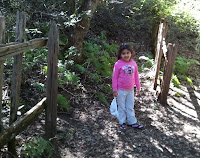
This is where we saw another artifact, a wooden fence(which has been re-constructed since the earthquake) which shows how a slip and strike earthquake can change the alignment of any structure that goes across the fault.

Station 5:
Springs or unusual wet areas are another feature of earthquake zone and this can be seen at this station.

Station 6:
Here you could see the sag pond in spring and may be just a shallow depression with no water in summer. The sag pond is formed when the 2 plates move away from each other creating a depression that gets filled with water from rain. The sag ponds are often found in the earthquake zones.

Station 7:
Here we saw 2 unusual oak trees, which fell during the earthquake. They were still rooted and hence kept growing. The lower part of the trunk is horizontal and the rest of the tree is vertical

Station 8:
At this station we saw the valley/depression formed either by land slide or fault movement, usually valleys are formed by flowing water.

Station 9:
At this station too we saw the bench like feature.

Along the trail the docent pointed out canyon oak, black oak trees, tan oak trees as well as Yerba buena herb(mint family), bay tree, red maid, hounds tongue (since the leaves are furry and have shape of a dog's tongue), poison oak etc. We also saw a tree with hollow trunk which was still alive because its cambium was still intact. The docent mentioned that in sudden oak death, the sapwood and cambium are destroyed and hence the tree dies.

This trail is fun and educational and we are looking forward to go again. The only caveat is the uphill drive on winding Page Mill road.

Sunday, March 27, 2011

San Francisco Garden and Flower Show 2011

Two weeks ago I had no intentions of visiting this show until I came across the kids event "Sproutopia" being hosted as a part of this show. The activities and workshops for kids seemed exciting and we decided to go and I was glad we did for this show is hosted annually.
Bonsai Planting We reached in time for the "Bonsai for kids" workshop. Each kid was given a tray, a pot, a chopstick and a bonsai. There were 2 instructors and about 2-3 volunteers helping the kids. Parents were specially instructed to stay back and just watch! It was about 45 minutes activity and at the end of it each kid had their own Bonsai planted in a pot and caring instructions to remember.
Bugs: Another workshop was on bugs and insects in the garden and kids got to touch the millipede and beetle as well as see various species of bugs in bug boxes with magnifiers. Some of the insects they saw were centipede, daddy longleg, wolf spider with egg sack on its back, honey bee, ladybug and potato bug. There were some specimens in of butterfly, moth and other beetles as well.
Among other activities were making fancy headbands, planting grass seeds in a sack to make a funny face, when the grass grows it would be the hair and kids can style it the way they want. A cool idea!
Carnivorous Plants: There were displays of carnivorous plants: sundew, pitcher plant, venus fly trap and butterworts. Each of the kids also got to take home their own pet carnivorous plant. We got to know a few interesting facts:

  • Venus fly trap has sensors on the inside of the leafy part and the it closes only when a buf touches sensors on the insides of both the parts and for atleast 20 secs. What a great way to avoid false alarm.

  • Carnivorous plants do not need any fertilizers as it can be strong for them and they can die.

  • They grow abundantly in the hot and humid climate.

  • They need to be watered with rain or distill water.
Miniature Gardens: There were displays of miniature garden's by elementary and middle school kids. Each of the garden had a theme and some were my kids favorites like: the island of blue dolphin, jack and the beanstalk, Alice in wonderland, Candyland etc. Award ribbons were displayed for the best ones, however we thought all of them were excellent.
After spending couple of hours in the kids section we headed to explore the actual show. We were amazed at the different plants and garden and indoor plant accessories that were displayed.
Garden displays: The most intriguiging part was the actual displays of the garden. They were a feat to the eye as well as wallet! Amongst the gardens were also the displays of corn snake and bearded dragon lizards!
Overall we spent about 4 hours at this place and could have spent more but the kids were really tired!

Saturday, March 19, 2011

Techno geek challenge at MOCHA

Museum of children's art, MOCHA hosts "Family Extravaganza" once a month and this week's theme was "Techno geek challenge". Kids and parents had to team up and make art out of electronic and waste material. As a reward, the kids would get a gift!

The variety of material that is offered to kids is really amazing(and that's why I like MOCHA!). The kids just have to bring in their imagination and create wonders. The kids were provided with circuit boards as a base and hot glue to make their structures. More

Since we recently had read a book "The moon", I and the little one decided to make a space craft. While rummaging through a miscellaneous box, the little one found a metal shaped foot and a thermacol piece(to be her moon) and she wanted to make a footprint on the moon, just like Neil Armstrong's! The elder one made the theme of Cinderella with a fancily dressed figure, carriage and dinner table etc.


After working on the art for more than an hour we decided to go to other tables. The kids made a fish tank scene in an empty DVD cover, some painting and played with clay.

Sunday, March 13, 2011

Aquarium spotlight @ MSI and Fujitsu Planetarium

Marine Science Institute (MSI) hosts aquarium spotlight days for parents and kids to come in to their facility and look at the marine life that they have. Its the time when kids can touch the fish, sponges, mussels, sea stars, crabs, leopard shark etc and feed some of them. The facility also has the skeleton of a 44 foot gray whale which some how made its way in to the Redwood creek in 1990.


The kids got to see the flat fish like the California halibut, diamond turbot, starry flounder which camouflage themselves really well with the sand and pebbles at the bottom of the ocean. There were tanks with surfperch, monkey eel, swell shark, sea anemone. The kids could hold the sea stars and got to see their tentacles and mouth. There was a huge tank with the leopard shark and kids fed it pieces of squid.


There was a lab set up where kids could look at the drop of water from the creek under microscopes and see the planktons like the diatoms, copepods etc.


We then took a stroll on the small beach next to the institute and observed dead barnacles on the poles, algae, shells and floats on the water.

After the marine science immersion I decided to take kids to the Fujitsu planetarium as it was the second last Saturday they would be open for this season. We watched the show "Cosmic journey" which was about the planets in our solar system. We then were shown the view of the sky that night and shown how to spot the Orion, the hunter (the belt, shoulders), Taurus the bull that he fights and Orion's 2 dogs. The narrator also showed the Leo constellation. He identified the stars Sirius, Beetle juice, Rigel, Polaris, Aldebaran and the star group Pleiades, the seven sisters. He pointed out that the stars which are red, orange color are cooler than the blue - white stars.

After the show we tried to identify some of the stars in the sky!

Saturday, March 5, 2011

Dr. Seussology @ Museum of Children's Art

My kids are always ready to go to any art event, so last weekend I took them to MOCHA(Museum of Children's Art). The theme was Dr. Seussology to celebrate Dr Seuss's birthday, and all the art was to be focused around it. There were 5 tables setup for the activities : making hats, clay modeling, painting, building figures from egg cartons and decorating them and making fish from cut-outs. The kids tried their hand at each of the tables.


There was a story reading program and the award -winning author Elissa Haden Guest read her book "Harriet's had enough!". The little one loved this session. Then the kids make drawings based on the story.


The museum also had display of top 150 selected drawings from the Cray-Pas Wonderful, colorful world 2011 contest. It is a national contest for K-8th grade. It was unbelievable that kids as small as Kindergarten and 1st grade could draw immensely detailed and colorful pictures.


It was a good place to spend couple of hours and we returned back with whole lot of art work.