Saturday, July 31, 2010

Bird Banding at SFBBO

SFBBO - San Francisco Bay Bird Observatory works on conservation of birds and restoration of the bird habitats. For tracking and studying the birds, their features, population and ensuring their wellness the volunteers of this organization catch the birds and band them(i.e put a ring having a serial number around their feet). Sometimes they catch an already banded bird in which case they examine the bird (like a check-up!) and make note of the birds statistics like molting, wing span etc.

The program that we attended was for families to see how the birds are caught, examined and banded. Since the area where the banding is done is a restricted conservation area, it is inaccessible for public. A special permit is issued to Audubon Society to do these programs couple times a year and that is how we could be part of this learning experience.


All the families met at McCarthy Ranch and we carpooled to the bird banding station at Coyote Creek (4-5 min drive). Various birds can be found here and you really need a binocular for this trip. We were taken for a walk about 20-35 minutes through the dense overgrowth to see the nets where birds are caught. There are about 50 nets and are operated only on certain days. The nets are very delicate and almost invisible to a flying bird. There is always someone walking past these nets to check if a bird is caught (Since the bird banding process is very intimidating for the birds, the volunteers want to keep it as short as possible). We were lucky to see an actual bird, song sparrow, caught in the net. It was removed from the net and put in to a cloth bag. On our walk we came across jack rabbits, a gray fox, and many birds like turkey vultures, kites, finches etc.


Back at the banding station, we watched 3 birds, a song sparrow, a common yellowthroat and a Bewick's wren which got caught in the nets. These were previously banded birds(on their legs), so the volunteer examined the birds, measured their weight and then let them go. The entire process took about 10-15 minutes for each bird. When the birds are caught they need to be held in a special way, so as to not hurt them as well as not to allow them to fly. Volunteers are trained in this technique.
The volunteer then showed us the bird skin displays of birds like the barn owl, red tail hawk, kingfisher, starling, blackbirds, house sparrow, wrens... and told us some interesting facts about these birds. The entire process of bird banding was very interesting and novel experience for me and my daughter.

Sunday, July 25, 2010

Trip to Yellowstone National Park, Day 2 - Utah and Teton National Park

We took the rental car from Salt Lake City Airport, Utah to Wyoming. As we drove from Utah, we got to see the jagged and rugged mountains of Utah, which look really "scary". Along the route we could see farms and ranches.We took the scenic by-ways through the Wasatch National Park and the Cache National Park before reaching the Teton NP. The mountains were clad with evergreen trees and we could see only greenery wherever our eyes set.


During this drive we spotted a fox, magpie birds, deer and plenty of field mice on the road. The road was pretty empty and we could take halts to click pictures.


As we got closer to Jackson Hole which is a town on the south of Grand Teton NP, the traffic increased. The drive along the snake river is marvellous with plain green fields and valleys surrounded by green mountains. Some of the mountain peaks were still covered with snow.Finally we reached the Teton NP and were amazed at the sight of Teton range. This range is called as teenage mountains as they are still rising or "growing" due to activity of the tectonic
lates beneath.


The visitor's center in the Teton NP has great exhibits that interest the kids. The rangers in the visitor's center gave us information as to which hikes would be best with kids. We first drove along the Gros Ventre river, a tributary of the snake river. There we spotted lots of Bison's, some crossing the road and momentarily halting the ongoing traffic.


Our next stop was the Jenny Lake, here we took a motor boat ride to the other end of the Lake. We hiked half way to the hidden falls, and came across the lower end of the falls. The force of the water that gushes here is breathtaking! There is a bridge from which you can witness this gushing underneath.


Next we went to the Jackson Dam/Lake where we were hoping to see the Trumpeter Swan. However we did not find any! We had to content ourselves by looking at the Pelican. After a very busy day finally we checked in to Colter Bay Log cabin. The overnight cabin stay was a good experience for the kids.

Trip to YellowStone National Park, Day 1 Train


Two months ago i.e. in the beginning of May-2010, I had the least idea that we will be going to YellowStone National Park. I had decided to take time-off to spend some time with my kids while they had their summer vacation. During the same time a colleague had visited Yellowstone NP and had described the natural wonders. I was struck by an idea to go on a trip to Yellowstone.There was not much time to plan, and with 2 kids under 10, I had to keep the trip flexible.

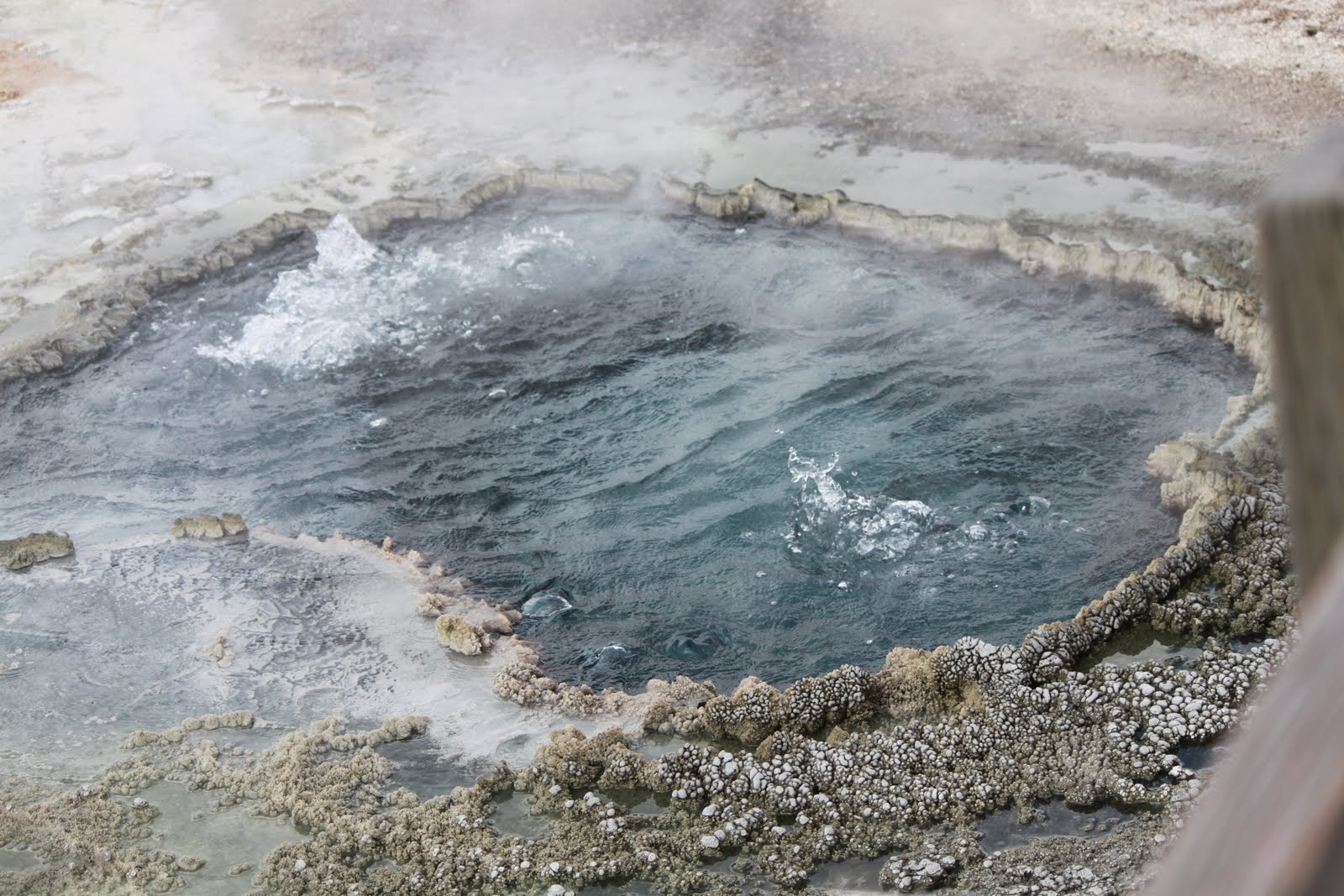
I started reading about this grand place, books and internet were my resources. I also made kids aware of what they should expect on this trip, enjoy nature's beauty and wonders. Wyoming is a gem with world's most beautiful wonderland as well as a historical past. We decided to cover all this in 7 days minus 1 day of train travel, however we were so mesmerized by the wonders that we had to leave the history for another visit. Yellowstone NP is truly a Natural Science Wonderland where chemistry, microbiology, geology have worked together to create a marvellous view.

Yellowstone NP is located in the Northwest of Wyoming. 90% of Yellowstone NP is in Wyoming and rest of it in Montana and Idaho. Yellowstone NP is part of the Rocky Mountains along which runs the continental divide. Yellowstone NP was formed as a result of volcanic eruptions millions of years ago.

I have divided these posts by day, since there was so much we enjoyed each day we were at the National Park.

Day 1(Train): It had long been my husband's wish to travel by train within US, but due to our fast-paced lives, it never came true. On this trip we decided to take things at our own pace and we wanted to enjoy nature. We had to choose between driving and taking the train, both would take almost the same time, however at the end of first one we would be dead tired! So we decided to take the train.


We took Capitol Corridor from San Jose to Emeryville and then boarded California Zephyr from Emeryville to Salt Lake City, Utah. I had booked the family room, so the kids could get some "space". The train travels from California to Nevada during the day time and the crosses in to Utah during the night. During the daytime we could see the striking summer time features of Sierra Nevada, Lake Tahoe, Truckee river. The view is superb!


In the family room we got 3 window seats to view the panorama, however the view from the dining car was amazing! We arrived at the destination early next morning at 4:00 a.m. MST.


I would recommend train ride only one way, since it would be boring and time consuming if taken both ways. The sleeping cars include free meals and first preference for dining. A little expensive, however worth a try.

Friday, June 25, 2010

Hike at Sunol Regional Wilderness

Last weekend our pick for the Sunday hike was Sunol regional wilderness near Fremont. As it was father's day my kids and I decided to give dad a good workout!


One of the staff members at the visitor's center helped us pick a trail along the Little Yosemite area which is a easy hike for a 4 year old and is a mix of open and shaded areas. The trail offers panoramic scenery of the green and brown mountains.

The Little Yosemite area is along the Alameda creek and as you walk on the trail you can hear the bubbling and flowing water, it is very soothing. I guess it is called so because there are few low water falls and flowing water stream and a lot of greenary around. We happened to spot a banana slug near the water. There were fish fry and tadpoles in the water.

We spotted butterflies : California Buckeye and the Variable Checkerspot.


The place seems to be very popular as we saw a good amount of crowd there. One thing that put my kids off and they decided that the park was not good was because some of the owners had left their dogs without leash.

Sunday, June 13, 2010

Lifecycle of a silkworm

The best way to learn science is to get close to nature and observe the surroundings. Nature has immense number of secrets and wonders which can intrigue kids as well as adults. Metamorphosis is one such amazing natural phenomenon.

This spring my preschooler's teacher got some hatched silkworms from the RAFT organization so she could have her students observe their lifecycle. She initially put them them in a shoe box
(as they were tiny) with plenty of mulberry leaves. The mulberry leaves is their preferred food, however they can also eat spinach or lettuce leaves. These worms were tiny light green and rusty.

The pictures below are of the silkworm, two weeks after they were brought:


However due to their enormous appetite they kept feeding on the mulberry leaves and grew. She moved them to a big plastic container with lid. All of them grew at different rates, however not a single worm crawled out of the shoe box or the plastic container!


As the silkworms grew the teacher started keeping rolls made out of thick paper sheet in the plastic container. 4 - 5 weeks after they were brought to school the first one crawled in to the roll and started making a coccoon. It made the coccoon within a day!


In the following 1-2 weeks most of the silkworms had gone in to their coccoons. Some of the coccoons were yellow. It is normal since those were wild silkworms and can have their coccoons in non-white color. As people prefer white color (as it could be dyed in to any color) they started breeding silkworms that would give only white silk.


For commercial use the coccoons are put in to boiling water and treated while the moth is still inside the coccoon. The enzymes secreted by the moths to break the coccoon damages the silk and hence they are not given any chance to come out.
After about 4-5 weeks of being in the coccoon, the silkworm moths finally came out. At this stage they do not need any food, nor do they fly. They go through the reproductory phase, lay eggs and die. These eggs can be stored in the refrigerator and used in the next spring to hatch more silkworms.


The silk from the cocoons is very strong and is stretched in to a hankerchief after treating the coccoons. It is then spun in to thread.


The entire lifecycle of the silkworm
(egg -> catterpillar -> coccoon -> moth) spanned over 2.5 months and almost everyday me and my kids watched it with great excitement.

Saturday, June 12, 2010

Wild Zone

After a very busy work schedule for last 2 weeks, I wanted to keep this weekend activity very light. So we went for the Wild Zones program. This program is free and focuses on "unstructured play in nature". All that the kids have to do is use their imagination and build!

Since this was our first visit, we were not very prepared for it. Just carried the basic necessities of a hot day... water,caps and sunscreens. When we reached this place first thing we saw was mucky water and kids standing in it and playing with the mud. The first thought that crossed my mind was... I am in the wrong place! I was very sure my kids won't even go near it, leave alone getting in to it. We watched the other kids play, and then slowly my kids went for the spade and shovel to dig in the mud. Good start, I thought.

After their heart was contented, we decided to build house with sticks. We tried our hands at building a teepee! Not bad for beginners! We decorated our house with some flowers and took some pictures.

We had a funfilled 1.5 hrs and the kids decided that next time they would come prepared to play in the mucky water too!

Sunday, June 6, 2010

Another afternoon at Ardenwood Historic farm

Our last visit (it happened to be our first visit too!) to Ardenwood Historic farm had filled my kids with a love for this place. The simple layout of the farm, the animals and the activities all contributed to it. When I gave my kids few options for places to visit over the weekend, they unanimously voted for Ardewood farm.

So here we were back at the farm and this time th kids enjoyed :

Bountiful bubbles: On a hot and breezy day it is fun to blow big bubbles with unusual bubble wands. These were made with 2 sticks on each side and a flat rope loop. There were simple metal wands for younger kids.

Vanilla Icecream: If you were born in olden days you would have to make your own icecream before eating it! The kids made vanilla icecream with an icecream maker from olden times, the cranking one. After mixing the ingredients in a vertical container, ice and salt(to lower the freezing point of the ice and make it more cold) were added around the container and kids had to turn the crank, so the mixture inside gets equally exposed to the lower temperature outside.

The kids then got to eat their icecream!

Old fashioned games: Kids were provided with things that they needed to play the old fashioned games such as walking on the stilts, potato sack race, balancing potato on spoon. They had fun trying out all of them.

This time we saw few more farm animals turkey, chicken and pheasant